Most backlink outreach emails never get an answer. And most likely is either the offer you are making to them, or the copy of the email itself.
When Backlinko and Pitchbox looked at 12 million outreach emails, only 8.5% got any response at all, and the 2026 cold email benchmarks are worse, with average reply rates sitting around 3%.
I’ve sent a lot of these, for SchedPilot and for clients of my agency, and a low reply rate almost never comes down to the template. It comes down to the offer you propose to them. When I give the other person something they actually want, they reply, and most of the time they say yes. Usually what they want isn’t money. You can think about the other person wants something and what do they want ? Most likely its an exchange, a backlink for themselves
Below is the whole process I use to get links and mentions for SEO and GEO, from choosing who to email to the one follow-up I send.
by the way, I offer b2b seo services, and I apply these tactics for my sites and for my customers. Check out my b2b seo agency
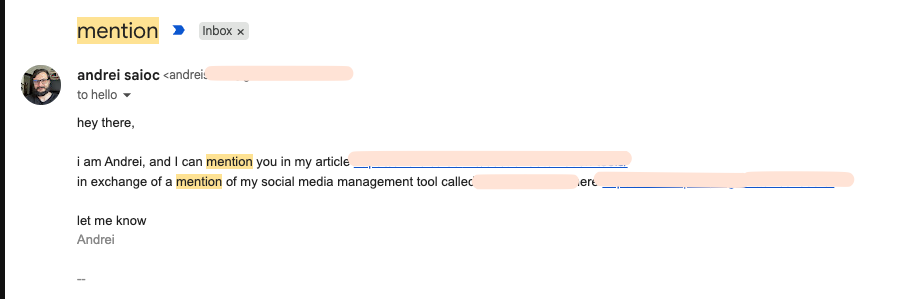
Here in this following email you have an example backlink request email template, for which i got a reply within 48 hrs
Decide which pages you actually want to be on
Before writing a single email, build a list of pages that would move something. For SEO that means pages already ranking for your keywords and sites in your niche that get real organic traffic. For GEO the list gets narrower: the pages ChatGPT, Claude, Perplexity and Google’s AI Overviews pull from when someone asks about your category. Those are mostly listicles (“best X for Y”), comparison posts and roundups.
A mention on a “best social media schedulers” listicle that AI assistants keep citing is worth more to me than a link from a DR 70 blog post nobody reads. The link helps you rank. The mention on a cited page gets you into the answer itself. (I wrote more about how this works in my post on marketing a SaaS with no ad budget.)
Finding them is simple, if a bit tedious. Google your money keywords and note the top ten results. Ask the AI assistants the questions your buyers ask and write down the sources they cite. If you have Ahrefs, Brand Radar shows which pages get cited in AI answers for a topic. Then check each site’s DR and organic traffic and cut anything with no traffic, because a site Google doesn’t send visitors to won’t do much for you either.
Keep the list small. Woodpecker’s 2026 data found that campaigns sent to fewer than 50 people averaged a 5.8% reply rate, nearly three times what large blasts got. Forty hand-picked targets will beat four hundred scraped ones every time.
Have something to offer in exchange
Almost every outreach email I receive says some version of “I loved your article, could you add my link?” That’s asking a stranger for a free favor. Why would they bother?
You need to bring something. In practice, the offer is one of these:
- Money, as a flat fee for a listicle placement or a sponsored post
- A sponsorship of their newsletter, podcast, YouTube channel or free tool
- A backlink exchange, ideally an A-B-C exchange rather than a direct swap
- Something from your product or audience, like a free lifetime account, a post to your social following, or a spot in your newsletter
Money is the fastest and the most expensive. My preference is the last two, because the best SEO backlinks are the ones you don’t pay money for. They cost nothing, and a link that came out of a genuine trade between two site owners looks like any other editorial link on the web.
What worked for me ?
Most things that worked for me is prividing them very niched listicles where their website would fit the best. The answer to this much faster than offering them money. Think about people at the other end of the line, are doing SEO as well.
How an A-B-C link exchange works
A direct swap (I link to you, you link back to me) is easy to spot, and Google’s John Mueller has said outright that this kind of arrangement goes against Google’s guidelines. An A-B-C exchange spreads the trade across three sites so no two of them link to each other.
Say site A is your SaaS, the one you want links for. Site C is a second site you own, a niche blog with some authority and traffic. Site B belongs to the person you’re emailing. B links to A, and in return C links to B. Everyone gets a link, and there’s no reciprocal pair anywhere.
I’ll be straight about the risk, though. Google treats any arrangement made to manipulate links as a link scheme, and A-B-C exchanges exist precisely to make the trade harder to see. So keep it small and keep it relevant. Only trade with sites your readers would actually benefit from, and put the link inside the content where it makes sense, never in a footer or a “partners” page. If someone proposes thirty swaps a month, walk away.
If you pay, label the link
Google wants paid links marked with rel=”sponsored”. Lots of people skip that, and I’d rather you didn’t. A sponsored link still sends referral traffic, and it still puts your brand name on a page that AI models read. For GEO, the mention is the point and the dofollow is a bonus.
Keep the email short enough to read on a phone
My rule is a subject line of one or two words and a body of two or three sentences at most. Anything longer and people get bored and delete it. Remember that most of these get read on a phone, between two other things.
To be fair, the data is split on subject lines. The Backlinko study found 36 to 50 character subject lines got the most replies, but that dataset is several years old. A newer analysis of more than 85 million cold emails found one to four word subject lines perform best. My own results match the newer one. A short subject line looks like it came from a colleague. “Partnership opportunity for your website” looks like it came from a tool, because it usually did.
Make the subject about them, though. “Your listicle” or the name of their site beats “Quick question”, and Backlinko found personalized subject lines lifted responses by about 30%. Here’s a full email I’d send for a listicle placement:
Subject: Your listicle
Hi Maria, saw your post on the best social media schedulers for agencies. Would you add SchedPilot? Happy to link to you in return from my marketing blog, DR 45 with about 8K organic visits a month.
Andrei
What I want, what they get, and a number that proves the offer is real. No paragraph about how much I enjoyed their writing. A sponsorship ask is even shorter:
Subject: Sponsor?
Hi Tom, do you take sponsors for the newsletter? I run SchedPilot and would like to be in a couple of December issues. What’s your rate?
If you offer a link, make it one worth having
This is where most exchange offers fall apart. If you offer someone a link from a DR 1 website with zero traffic, they will not answer. Anyone who has run a site for a while checks, and they’ll paste your domain into Ahrefs or Semrush before reading your second sentence.
As a rough guide, the site you offer should have a DR close to or higher than theirs, and real organic traffic. Of the two, traffic matters more to me. DR can be pumped up with junk links. Traffic is much harder to fake, and it tells the other person Google actually trusts the site.
Put the numbers in the email, like I did above. It saves them the lookup and answers the only question they really have.
If you don’t own a site like that yet, don’t offer exchanges yet. Offer money, a sponsorship or product access, and build a second site on the side. A niche blog that earns its own traffic turns into a link exchange asset you can use for years.
Follow up once, then stop
I send one follow-up three or four days later, as a reply in the same thread. It’s worth it: Backlinko found a single follow-up raised replies by 65.8%, and SmartReach’s 2026 benchmark puts follow-ups at roughly 42% of all cold email replies. After that I stop. Emailing someone a third and fourth time after they ignored two is how domains end up in spam folders.
The follow-up is one line. “Hi Maria, any thoughts on this?” works fine.
Protect the domain you send from
If you’re sending more than a handful a day, don’t send from your main company domain. Use a separate domain, warm it up for a couple of weeks, and verify every address before you send. Verified lists get roughly twice the reply rate of unverified ones, according to Woodpecker, mostly because your emails actually land in the inbox. I keep each inbox to a few dozen emails a day.
Then track everything in one spreadsheet: site, DR, traffic, contact, what you offered, date sent, follow-up date, reply, and whether the link went live. Check the live links once a month. Some quietly disappear when the page gets updated, and a polite nudge usually brings them back.
Backlink outreach FAQs
What is backlink outreach?
Backlink outreach means contacting site owners, editors or writers and asking them to link to or mention your site, usually in exchange for something. It’s the main way to get links from specific pages you’ve chosen rather than waiting for them to happen.
What’s a good reply rate for link building outreach?
The average cold email reply rate in 2026 is around 3 to 3.5%. Snov.io puts a truly good reply rate at 10%. With a small, hand-picked list and a real offer, you should clear 10%. If you’re well under 5%, the offer is usually the problem, not the wording.
Are link exchanges against Google’s guidelines?
Excessive link exchanges are. Google’s spam policies list them as a link scheme, and John Mueller has confirmed that “you link to me and I’ll link back” arrangements break the guidelines. A handful of relevant links between sites that genuinely belong together is a normal part of the web. Dozens of swaps a month is the kind of pattern that gets noticed.
What is an A-B-C link exchange?
It’s a three-way exchange. Site B links to your site A, and in return a third site you control, site C, links to site B. No two sites link to each other directly, so it doesn’t look like a reciprocal swap. It still counts as a link scheme if Google decides it was arranged to manipulate rankings, so keep it relevant and low volume.
Should I pay for backlinks?
You can, and plenty of companies do, especially for listicle placements. Google expects paid links to carry rel=”sponsored”, which means they pass less ranking value, but they still bring referral traffic and brand mentions that AI assistants pick up. Try a trade first. Pay when you have no trade worth offering or when the page is too valuable to wait on.
How long should an outreach email be?
Two or three sentences in the body and a one or two word subject line. Say what you want, what they get, and include one number (DR, traffic or price) that makes the offer credible.
How many follow-ups should I send?
One, three or four days after the first email, in the same thread. A second follow-up is fine if you have something new to add, like a better offer. Beyond that, you’re hurting your sender reputation more than you’re helping your reply rate.
Does backlink outreach help with GEO and AI search?
Yes. AI assistants lean heavily on listicles, comparison pages and roundups when they recommend products, so getting mentioned on the pages they cite is one of the most direct ways to show up in AI answers. For GEO, an unlinked or nofollow mention on a frequently cited page can matter as much as a dofollow link.
What DR do I need before I can offer a link exchange?
There’s no fixed number, but aim for a DR similar to or higher than the site you’re emailing, plus real organic traffic. A DR 40 site with a few thousand monthly visitors will get replies. A brand-new site with no traffic won’t, whatever its DR says.
What tools do I need for backlink outreach?
Not many. Ahrefs or Semrush to check DR and traffic, an email finder like Hunter, a separate sending domain, and a spreadsheet. Outreach platforms like Pitchbox or BuzzStream help once you’re sending at volume, but for a list of forty targets, Gmail is enough.