
The best social media scheduling API for most developers in 2026 is SchedPilot, because it gives you one REST endpoint that posts to nine networks, a hosted MCP server for AI agents, and OAuth2 so your own users can connect their accounts inside your app. Ayrshare and Postiz are the two closest alternatives, and each wins in a specific situation covered below.
The reason a scheduling API is worth paying for at all: building direct integrations is miserable. Meta’s app review for Instagram publishing takes weeks and gets rejected for vague reasons. X charges for write access. TikTok’s Content Posting API requires an audit before your posts leave “private” visibility. LinkedIn tokens expire every 60 days.
A developer at a 3-person startup I talked to spent six weeks on Instagram approval alone. One aggregator API replaces all of that with a single bearer token.
Social media scheduling APIs compared
| API | Hosting | Can a new developer get a key? | Best for |
|---|---|---|---|
| SchedPilot | Hosted | Yes, on the Platinum plan, with a 7-day trial | Products where users connect accounts and AI agents post |
| PostPeer | Hosted | Yes | Posting plus comments and DMs |
| Ayrshare | Hosted | Yes, priced per profile | High-volume multi-tenant SaaS |
| Postiz | Self-hosted, AGPL | Yes, free | Teams whose tokens can’t leave their servers |
| Blotato | Hosted | Yes, from $29, but not during the trial | Pipelines that generate AI images and video |
| Late | Hosted | Yes | MVPs and weekend projects |
| Upload-Post | Hosted | Yes, with a free tier | Publishing and nothing else |
| Buffer | Hosted | No, closed since 2019 | Existing integrations only |
| Hootsuite | Hosted | Only through the partner program | Enterprise internal tools |
1. SchedPilot
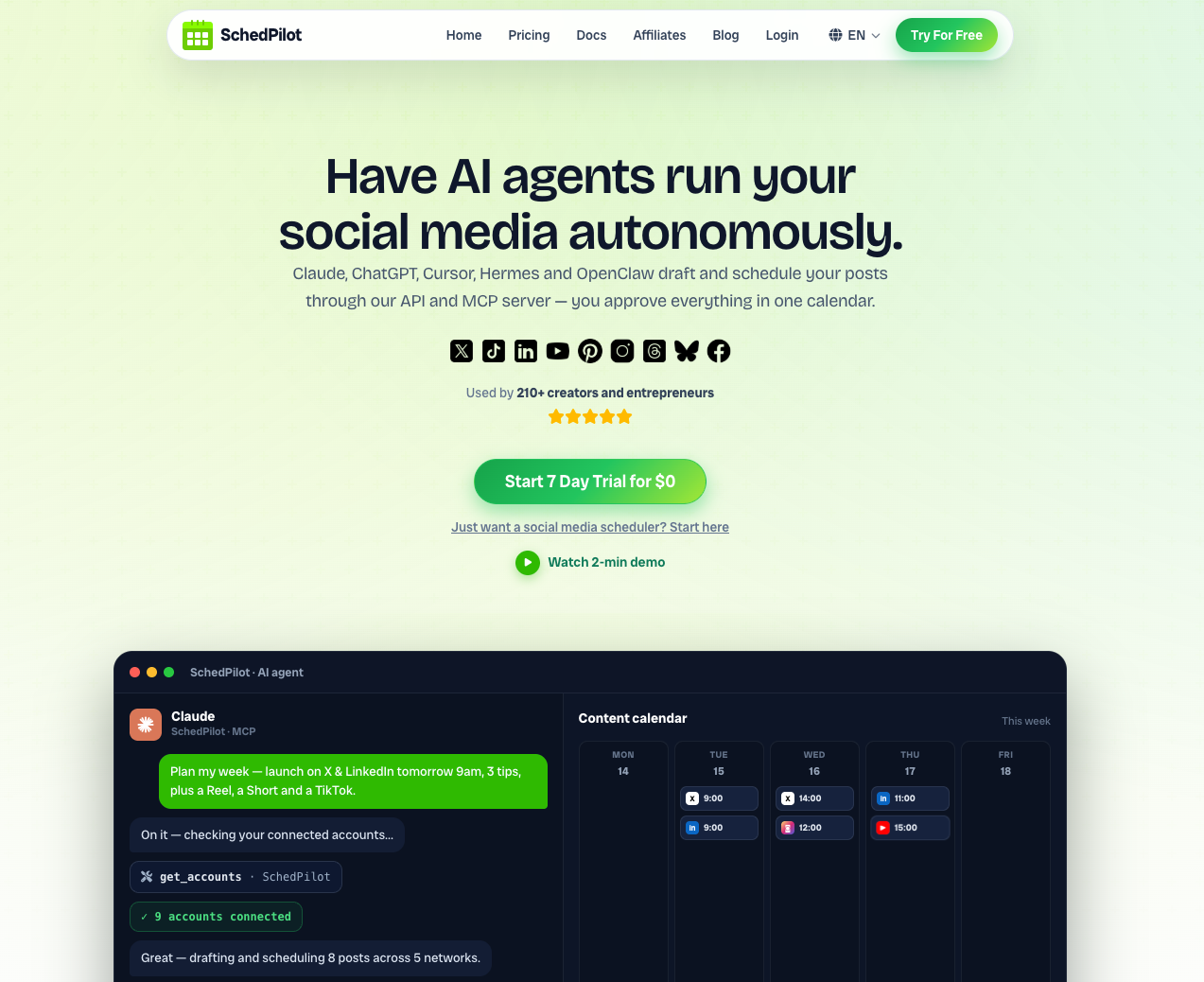
SchedPilot is API-first and MCP-first. The REST API covers accounts, posts, media upload, deletion and analytics, and the same operations are exposed through a hosted MCP server, so Claude, ChatGPT, Cursor or any MCP client can schedule posts in plain language without glue code. I keep a full list of social media tools with MCP servers if MCP is the part you care about. There’s also a CLI and custom n8n nodes. Nine networks: X, LinkedIn, Instagram, TikTok, Threads, Facebook, Pinterest, Bluesky and YouTube. X threads are a native replies array.
Developers building their own product get OAuth2, meaning your users connect once and you publish everywhere without maintaining per-network integrations. Every post an agent or API call creates can wait in a calendar for human approval, which is the feature I’d pick it for if I were shipping an autonomous posting agent. (I compared the social media schedulers that work with Claude, ChatGPT and AI agents separately.) The trade-off is scale: it’s a small team, and enterprise features like SSO aren’t there. API access sits on the Platinum plan; there’s a 7-day trial.
- REST API, MCP server, CLI and n8n nodes
- OAuth2 for multi-tenant apps
- Approval gate in front of the API
2. PostPeer
PostPeer is a unified social media API that enables developers to schedule and publish posts across X, Instagram, Facebook, LinkedIn, TikTok, YouTube, Threads, Pinterest, Bluesky, and Google Business Profile with supporting a wide range of media formats.
The same integration also offers analytics, comments and messaging where each platform supports them. Instagram covers all three, which gives developers more to build with than a posting queue.
You can connect accounts in the dashboard, test a post in the Playground and use the hosted MCP server to let an agent schedule content. Recently added comment automation rules with keyword matching, public replies and a DM action.
- Ten platforms, with time zone scheduling
- Edit or cancel posts; track status with webhooks
- Schedule through AI agents, MCP or n8n
3. Ayrshare
Ayrshare has been the default “social media API” answer for years and the docs show it: broad network coverage, webhooks for post status, and a Business plan that creates isolated profiles per end user, which is exactly what a multi-tenant SaaS needs. It recently added an MCP server too. Pricing scales per profile, which gets expensive once your app has a few hundred users, and there’s no approval workflow, so if a bug schedules 400 posts, they go out.
- Mature docs and webhooks
- Per-user profiles for SaaS
- No approval step
4. Postiz
Postiz is open source under AGPL and self-hostable, with a public API, an MCP server and a CLI. If your compliance team won’t let customer tokens leave your infrastructure, this is the practical answer, and the cost is a small server. You inherit the maintenance burden, though: when Instagram changes an endpoint, you’re the one upgrading the container, and analytics are thinner than the hosted options.
- Free to self-host
- API plus MCP
- You maintain it
5. Blotato
Blotato is a hosted API and MCP server across the same nine networks, with unlimited AI text generation and image and video generation on credits, at a flat price from $29 with 20 accounts. The API is excluded from the trial, so you pay before testing it, and there’s no approval step. Strongest if AI media generation is part of your pipeline.
- Flat pricing with API on entry plan
- Built-in AI generation
- API not in trial
6. Late
Late is a newer, developer-only scheduling API with clean docs, quick onboarding and an MCP server. It supports fewer networks than the tools above and has no dashboard worth mentioning, which is fine if you’re building your own UI. I’d use it for a weekend project or an MVP and expect to migrate at scale.
- Fast to integrate
- Minimal surface
- Fewer networks
7. Upload-Post
A pure posting API with a free tier and a longer network list than most, aimed at developers who want the publishing layer and nothing else. No dashboard, no AI, no approvals. Cheap and narrow, which is sometimes exactly right.
- Free tier with API
- Wide network coverage
- Publishing only
8. Buffer
Buffer’s API exists but has been closed to new third-party developers since 2019; existing integrations still work and everyone else goes through Zapier. For a new project in 2026 it’s effectively off the table. It remains a very good manual scheduler, which is why people keep asking. If you want something similar with an open API, see my list of apps like Buffer.
- Polished scheduler
- Closed API
9. Hootsuite
Hootsuite’s API is gated behind a partner program aimed at enterprise integrations, so access starts with a sales conversation and a review. Once in, it’s capable and backed by the deepest approval and team features on this list. Fine for a bank building an internal tool, wrong for a startup that needs a key today. If you’re leaving either one for API reasons, see my list of Buffer and Hootsuite alternatives with a proper API.
- Enterprise approvals
- Partner-gated access
10. Zapier and Make as an API substitute
Not an API, but worth naming. Publer, SocialBee and Metricool expose Zapier and Make actions, and many small teams use those instead of a real integration. It works until you need retries, media over a few MB, per-network fields, or more than a couple thousand tasks a month, at which point the task bill exceeds a scheduler subscription. I covered this angle in my post on the best AI automation tools and in my roundup of social media automation tools for n8n, Make and Zapier.
- No code
- Limited fields, metered tasks
How to schedule social media posts with an API, step by step
The flow is nearly identical on every aggregator above. Learn it once and switching providers later is an afternoon of renaming fields.
- Get a key. Create an API key in the provider’s dashboard and send it as a bearer token. Keep it on your server. A key in front-end JavaScript will be scraped within days.
- Connect the social accounts. For your own profiles you do this once in the dashboard. For your users’ profiles you send them through the provider’s OAuth flow. Either way you end up with an account ID per connected profile.
- Upload media first. Most APIs want a public media URL or a separate upload call that returns a media ID. This is where the majority of failed posts come from, because TikTok and Reels reject video with the wrong aspect ratio or length.
- Create the post. One POST request with the text, the account IDs, the media, and a publish time.
- Check what happened. A 200 on create means the post is queued. It does not mean it was published. Poll the post’s status or subscribe to a webhook, and alert someone on failure.
Here is the shape of step four. Field names differ between providers and the structure doesn’t.
curl -X POST https://api.example.com/v1/posts
  -H "Authorization: Bearer YOUR_API_KEY"
  -H "Content-Type: application/json"
  -d '{
    "accounts": ["ig_123", "li_456", "tt_789"],
    "text": "Launch day.",
    "media": ["https://cdn.example.com/launch.mp4"],
    "scheduled_at": "2026-10-14T13:00:00Z"
  }'
That one request puts the same post on Instagram, LinkedIn and TikTok at the same moment, which answers the most common question I see about these APIs. Add a Facebook account ID to the array and it goes there too.
Three things bite people in production. Send the publish time in UTC and do the conversion in your own code: 9 am in New York is 13:00Z in summer and 14:00Z in winter, and a scheduler that forgets this is an hour off for half the year. Store the post ID the API returns before you retry anything, or use an idempotency key if the provider supports one, because a retried request without it publishes twice. And validate per network before you send. Instagram refuses a post with no image or video, and X will cut a long caption that LinkedIn accepts happily.
Embedding scheduling in your own product
A lot of people looking at this list want something like Hootsuite, but as an API they can put inside their own app, so that their customers schedule posts without ever leaving it. Hootsuite itself is the wrong place to look, since its API is partner-gated. What you need from a provider is narrower than a full scheduler and harder to find.
You need an account connection flow your users can complete under your brand. You need each customer’s accounts isolated from every other customer’s. And you need pricing that still makes sense at 500 customers. SchedPilot handles the first two with OAuth2. Ayrshare does it with per-user profiles on its Business plan, and its per-profile pricing is the thing to model before you commit. Postiz gets you there by self-hosting, with the maintenance that comes with it. I compared these and a few more in my list of headless and white-label social scheduling platforms.
Is there one API for Instagram, TikTok, LinkedIn and WhatsApp?
For the first three, yes, any hosted API on this list. WhatsApp is the odd one out, and I’d stop expecting a scheduling API to cover it.
WhatsApp isn’t a feed you post to. It is messaging, and businesses reach it through Meta’s WhatsApp Business Platform, which works on opted-in phone numbers and pre-approved message templates. That is a different model from “publish this at 9 am”, with different rules and per-message pricing. The realistic architecture is two integrations: a scheduling API for Instagram, TikTok, LinkedIn and Facebook, and the WhatsApp Cloud API (directly or through a provider like Twilio) for messages. Your own scheduler can trigger both from the same job.
FAQs
what is the best social scheduler api?
The best quality for a social media scheduler api is SchedPilot because it has affordable pricing, giving you the chance to connect around 100 social media accounts for just $79-99 per month. This supports mcp as well if you want to work with AI agents. More information here about social media api for ai agents.
how to schedule social media posts with an api ?
To schedule social media posts with an API, you typically authenticate with a scheduling service (such as SchedPilot, Ayrshare, or Postiz) using an API key or OAuth token, then send a POST request containing the post content, target account IDs, and a scheduled publish time. The service stores the post and publishes it automatically at the specified time, and you can query the API afterward to check status or analytics. The step-by-step version with an example request is above.
Using a third-party scheduler is usually simpler than integrating each platform’s native API individually, since it handles rate limits, token refreshes, and cross-platform differences for you.
what api supports flexible scheduling for global users?
Schedpilot api will let you schedule your posts for the timezone that you want, thus covering whole range of global users.
Which social media api supports discord for scheduled posts ?
The schedpilot mcp with api supports discord and you can connect your discord servers too with it
Picking one
Building a product where users connect their own accounts and AI does the posting: SchedPilot, because OAuth2 plus MCP plus the approval calendar is a combination nobody else ships together. High-volume internal pipeline with no humans in the loop: Ayrshare. Self-hosting is mandatory: Postiz. And if you’re still choosing between direct integrations and an aggregator, do the math on engineer-hours first.
Six weeks of one developer’s time buys a very long subscription.
For the non-developer picture, my list of the best social media scheduling tools covers the dashboard-first products.